
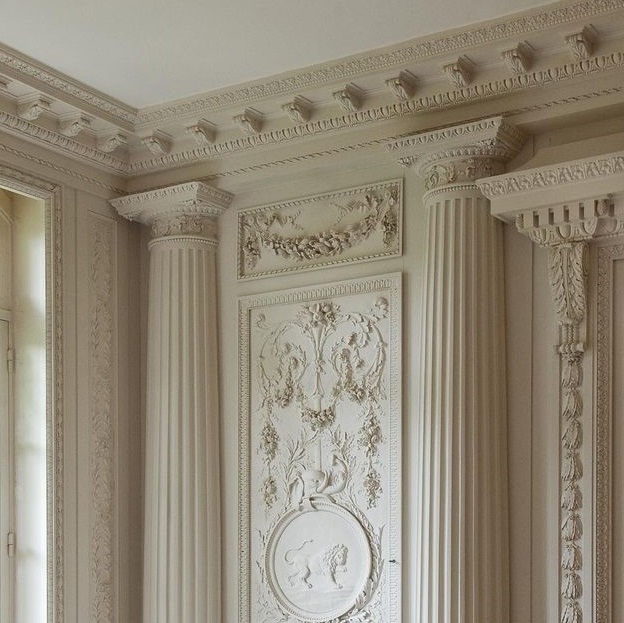
In this article, we will discuss columns, pillars, and pilasters. Do they still have a place in modern times? Where are they used? What roles do they serve? What types exist? How are they manufactured today using modern technologies and computer numerical control (CNC)? And how can our 3D STL models, available on the website and made to order, assist you? We will also provide links to relevant sections that may be useful to you.
About Columns:
Columns have been an integral part of architecture since antiquity. In ancient times, there were entire orders (specific characteristics typical of columns). For example, the Corinthian order, the Ionic order. Columns of each type differed in decor, size, length, and thickness.
Today, columns, pillars, and pilasters are often found in modern interiors. These majestic elements can be not only functional (since columns originally served as supports) but also decorative. They add elegance and style to interiors, imparting a special charm and helping to emphasize the chosen interior style.
From a functional perspective, one of the most popular uses of columns in modern design is as supporting elements. They can support ceilings and overhead structures, providing additional stability.
Secondly, columns can be used to create open floor plans. They visually divide space into functional zones without creating a sense of enclosure, blocking light, or obstructing passage.
Thirdly, they are often used as decorative elements. They can be clad in various materials such as marble, wood, or metal, allowing them to complement the interior style. They can also be made from different materials. Columns may be adorned with carvings or reliefs, giving them a unique appearance.
It is important to choose the right shape, material, and placement of columns so that they harmoniously fit into the overall interior style and create a cohesive space.
Small columns and pilasters often serve as decor for furniture. They can adorn kitchen sets, cabinets, beds, and tables. Finally, columns and pillars are used to decorate portals, shelves, staircases, balconies, and railings. Columns can also be found in the design of gazebos, fountains, balustrades, and more.
Thus, columns and pillars have a wide range of functions.
Styles:
Columns and pillars can be made in a variety of styles.
In antiquity, there were three key styles. The Doric style was characterized by its simplicity and strict forms, with the top of the column (acroterion) featuring a square decoration. The Ionic style was more elegant and refined, with a capital adorned with spiral leaves and volutes at the top. The Corinthian style was considered the most sophisticated and luxurious, with a capital resembling an open acanthus flower. There was also a composite style, combining features of the Ionic and Corinthian styles with greater creativity. Each of these styles had its uniqueness and was used in various architectural structures, giving them a distinctive character and style.
Additionally, columns can be designed in styles such as Baroque, Art Deco, Provence, Modern, Gothic, and more. Pillars can be crafted in an Old Russian style. There are also church-specific pillars. And so on.
Today, the choice of design depends solely on the designer's vision. Columns and pillars are adorned with flowers and leaves carved into the material. They are complemented with masks and bas-reliefs featuring images of people and animals. They surprise with intricate shapes and unusual decor.
Manufacturing:
Columns and pillars of any size are now manufactured using CNC (computer numerical control) machines. This requires a CNC machine, cutters, material, and a 3D model.
The machine quickly and accurately creates the desired relief, cutting the column and its capital.
Materials used can include wood, certain types of foam, plaster, and stone.
CNC machines allow for high-quality production of any number of items in the shortest possible time. Automation speeds up the process, reduces the risk of errors, and ensures excellent results.
Models:
It can be said that variations of columns include pillars, half-pillars, and pilasters (an imitation of a column, but essentially a bas-relief—flat on one side and relief on the other).
You can choose ready-made models of all these elements on our website.
The following sections are available to you:
-
Column Models (featuring options with spiral columns, fluted columns—with longitudinal grooves, columns adorned with carved flowers and leaves, and many other types of decor).
-
Capital Models—the top part of a column, beautifully decorated with acanthus leaves or any other carved decor.
-
Pilaster Models—flat columns.
-
Pillar Models—architectural elements similar to columns but with a slightly simpler design, without a capital at the top, featuring beautiful carved decor and varying cross-sectional shapes along the pillar.
-
Half-Pillar Models—small pillars suitable for decorating balconies, portals, staircases, shelves, and more.
-
Church Pillar Models—featuring patterns and ornaments characteristic of Orthodox decor. Such pillars are used in decorating churches, church furniture (e.g., tables, lecterns, icon stands), and iconostases (where icons in rows are often separated by pillars).
In addition to ready-made models, you can always contact us for custom orders. We will develop a model in the shortest possible time, precisely matching your requirements as outlined in your technical specifications. We guarantee high quality, detailed design, and excellent results.
Call, write, and ask questions.
You may also be interested in other articles on our website:
-
Coffered Ceilings. Manufacturing on CNC Machines. Models.
-
How to Make Money with CNC Machines? Business Ideas.
-
What is the STL Format? How Did It Originate? Features. Where to Buy Models?