
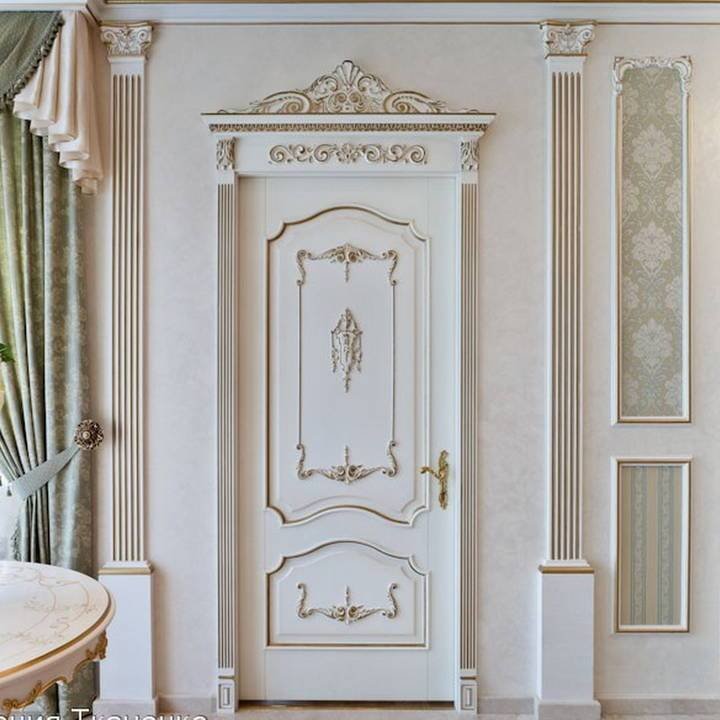
In this article, we will discuss how to create doors with beautiful carved decor using CNC machines. On our website, you can purchase ready-made models of doors and door overlays or order the development of custom models based on your individual requirements.
Advantages of Using CNC Machines for Door Manufacturing:
Manufacturing doors on a CNC machine combines modern technology with traditional craftsmanship, enabling the creation of unique solutions for any interior.
-
Precision: Computer Numerical Control (CNC) ensures high accuracy in material processing, which is critical for achieving perfect shapes and creating intricate carved details, especially when repeating the same decor multiple times.
-
Versatility: CNC machines can produce not only standard shapes but also complex carved elements, turning doors into true works of art.
-
Minimal Finishing Work: The final steps include light sanding, varnishing, and painting, giving the products durability and aesthetic appeal. The machine handles the bulk of the work.
-
Design Process: The process begins with design, using specialized software to create a virtual model of the door. This allows for visualization of the final product and necessary adjustments before physical work begins.
-
Material Flexibility: CNC machines can work with almost any wood material, whether solid wood, plywood, or composites.
-
Speed and Accuracy: The machine guarantees fast production and error-free results.
Thus, using CNC technology in door manufacturing ensures unparalleled quality and uniqueness, meeting even the most refined customer needs.
Materials:
The following materials are typically used for manufacturing doors on CNC machines:
-
Solid Wood: Known for its strength, warmth, and aesthetic appeal, solid wood offers excellent sound insulation, a variety of textures and colors, and eco-friendliness. Its only drawback is the high cost. Solid wood is used to produce premium-class doors of exceptional quality.
-
MDF (Medium-Density Fiberboard): This material offers a balance of affordability and high quality. It is also excellent for milling and creating beautiful doors in various styles.
-
Particleboard (Chipboard): A less common option, often used for budget-friendly doors. This category also includes plywood constructions. These doors are typically simple, straight panels with minimal decorative elements or relief. However, carved overlays can be added to achieve a specific style.
Styles:
Doors with carved ornaments are suitable for the following stylistic directions:
-
Classic Style: Often an umbrella term for various classic-inspired directions, including Baroque, Antiquity, Art Nouveau, Art Deco, Empire, Shabby Chic, and Colonial styles. These doors feature classical ornaments, symmetrical details, vertical columns and half-columns, moldings, pilasters, and various decorative elements. They attract attention and evoke admiration from both homeowners and guests.
-
Neoclassicism: A modern interpretation of classicism. Doors in this style retain some classical features but appear simpler and more concise, with fewer decorative elements.
-
Provence Style: Doors in this style may feature floral carvings or pastoral motifs, or they may have a more restrained design with classical elements.
-
Art Nouveau: Characterized by asymmetrical decorative elements and floral patterns.
-
Japanese Style: May include elements of Japanese culture.
-
Arabian Style: Doors adorned with intricate Arabic calligraphy and motifs.
Milling may not be used for doors in styles such as loft, minimalism, Scandinavian, or high-tech, although they may feature straight lines, intersecting elements, or textures like brick or stone.
Stages of Creating Milled Doors:
-
3D Model Development: The first step involves creating a 3D model to formulate the overall concept and visual appearance of the product. Modern software allows for previewing the final result.
-
Model Adaptation for Equipment: The model is adapted for the machine, specifying milling depth, width, speed, and cutting shapes. A control program is created.
-
Tool Preparation: The appropriate milling cutter is installed, and the material is secured.
-
Finishing: Includes manual sanding, application of tinting agents, oil, wax, or varnish.
Ready-Made 3D Models:
You can purchase ready-made 3D models of door overlays, complete door models, and individual elements (such as columns, capitals, and various overlays) on our website. We offer a wide selection of high-quality models at reasonable prices, both in stock and made-to-order.
You May Also Be Interested In:
-
Wardrobes in Different Styles: 3D Models for CNC.
-
Interior Products in Baroque Style on CNC Machines. Models.
-
How to Earn with CNC Machines? Business Ideas.